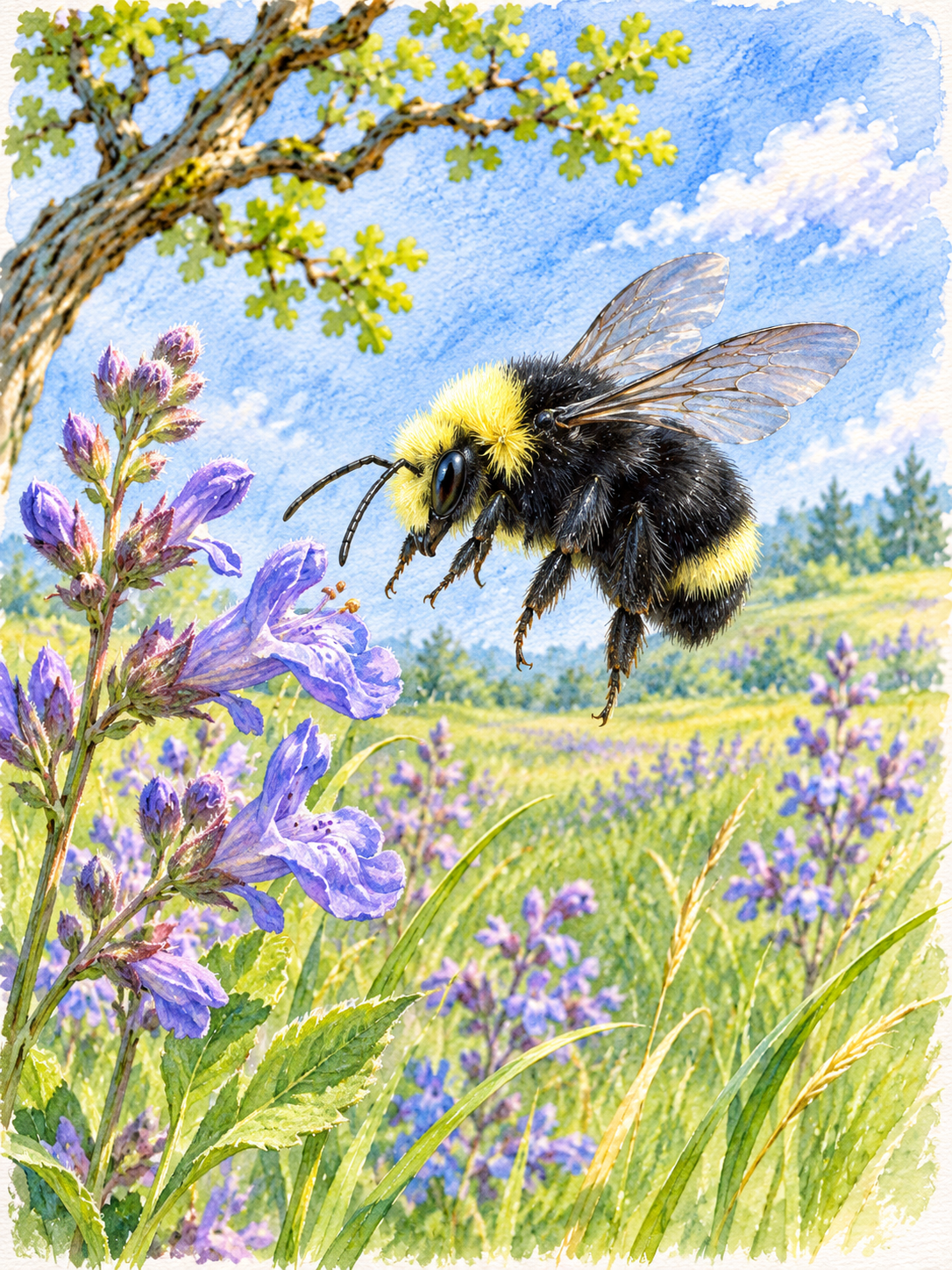
Original watercolour of a fuzzy Yellow-faced Bumble Bee hovering among purple meadow blossoms beneath Garry Oak branches in spring.
Yellow-faced Bumble Bee · Original watercolour illustration · BC Watercolour Art

Wildlife · Artwork No. 03 · Life in a Garry Oak Meadow

Yellow-faced Bumble Bee

Bombus vosnesenskii

The Yellow-faced Bumble Bee is a striking black-and-yellow pollinator whose range has expanded across southwestern British Columbia. Once known from very few provincial specimens, it is now well documented in coastal areas, including Vancouver Island. It visits many kinds of flowers and is a visitor to Garry Oak landscapes, not a specialist of those meadows. [1] [3] [4]

How to recognize it
Yellow face and front of thorax, mostly black body, one yellow band near the rear [2]
Where to look
Flower-rich open areas, gardens and meadow habitats [4] [5]
Found in B.C.
Vancouver Island, the Lower Mainland and parts of the southern Interior [1] [3]
Bee family
Apidae, the family of bumble bees and their relatives [3]

A visitor from the meadow

Download the artwork

Enjoy the full original PNG illustration. Free to download and reuse, with no attribution required.

Download watercolour PNG

This permission applies to this original illustration only. Outside photographs and research materials are not included.

A closer look

Field notes among the flowers

Discover the yellow markings, seasonal life and changing distribution of this distinctive bumble bee.

01 / Identification

A bright face and a yellow band

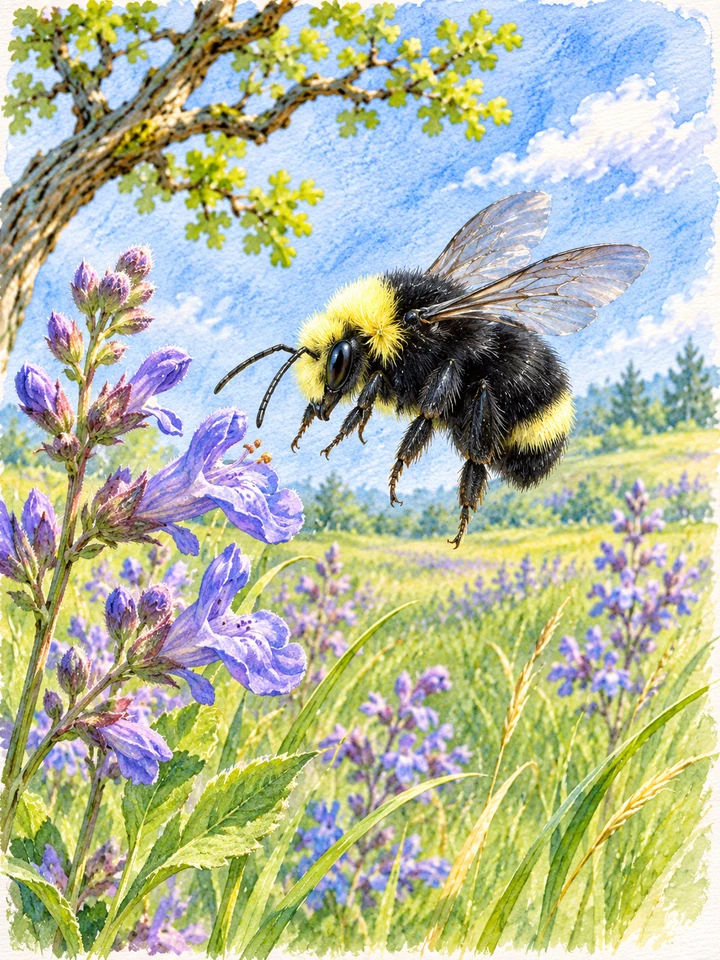
This bee has yellow hairs on its face and across the front of its thorax, behind the head. Most of its body is black, except for a conspicuous yellow band on the fourth segment of its abdomen, closer to the rear. Its wings are smoky brown. Similar-looking bumble bees occur in the region, so colour alone is not always enough for a definite identification. [1] [2]

02 / Habitat and range

A changing map of B.C.

Historically known from very few provincial records, the Yellow-faced Bumble Bee has expanded in southwestern B.C. Researchers have documented it in the Okanagan, Lower Mainland and on Vancouver Island, including near Garry Oak sites in the Cowichan Valley. Its range extends from southern British Columbia through the western United States to northern Baja California, Mexico. Local abundance can differ greatly among sites. [1] [3] [5]

03 / Ecological relationships

A flexible flower visitor

Like many bumble bees, this species collects pollen and nectar while moving among flowering plants. In one 2021 Gulf Islands study of Garry Oak ecosystems, females observed foraging below 1.5 metres were most often seen on non-native hairy cat’s ear and ribwort plantain. That is a finding from those survey sites, not a rule for every meadow. Its presence near camas does not establish that it is a camas specialist. [2] [4] [6]

04 / Seasons

Queens, workers and summer males

Bumble bee colonies generally last one year: a queen starts a colony, workers appear as the season progresses and males emerge later. In the Gulf Islands survey, the first bumble bees observed were queens, workers appeared after early May and males from July. Those observations covered several bumble bee species, not just this one. A Yellow-faced Bumble Bee queen was also collected in Victoria in late April 2012. [1] [4]

05 / A changing community

Not all bees share the same story

Scientists have documented this bee spreading through the province at a time when some other bumble bee species have declined. On Galiano Island, researchers reported it as a relatively recent arrival, but it was still the least abundant bumble bee in their sampling. An expanding species should not be mistaken for proof that all pollinators are thriving. [1] [5]

06 / Interesting details

An old specimen, a new chapter

One of the earliest recorded B.C. specimens was collected near Osoyoos in 1925 and described in a publication from 1951. The yellow facial hairs and rear abdominal band help distinguish this species. Researchers continue to investigate why it expanded so rapidly in the province; no single cause has been established. [1] [2]

Further reading

Research & references

Sources reviewed on 6 November 2026. This original watercolour is an artistic interpretation, not a diagnostic identification plate.

  1. Fraser, Copley, Elle & Cannings (2012) · Range expansion in BC Original research: BC specimen record, 1925 Osoyoos collection, range expansion, distinguishing colours and uncertainties.
  2. Koch, Strange & Williams (2012) · Bumble Bees of the Western United States USDA Forest Service identification guide, especially pages 74–77: yellow face, front thorax and fourth abdominal segment.
  3. E-Fauna BC · Bombus vosnesenskii Species name, family, native status and regional distribution; conservation ranking date needs independent verification.
  4. Beckett and colleagues (2022) · Deer, flowers and bumble bees 2021 Gulf Islands survey of bee activity, seasonality, flowering plants and deer browsing; a 2023 corrigendum corrected map site labels.
  5. Simon, Best & Starzomski (2023) · Bumble bees on Galiano Island Historical and recent observations on Galiano Island; recent arrival of this species and variation in local abundance.
  6. Garry Oak Ecosystems Recovery Team · Garry Oak ecosystems Context for Garry Oak meadows and the broader ecosystem, not evidence of a specific bee–camas interaction.
Back to Life in a Garry Oak MeadowArtwork No. 03 of the collection