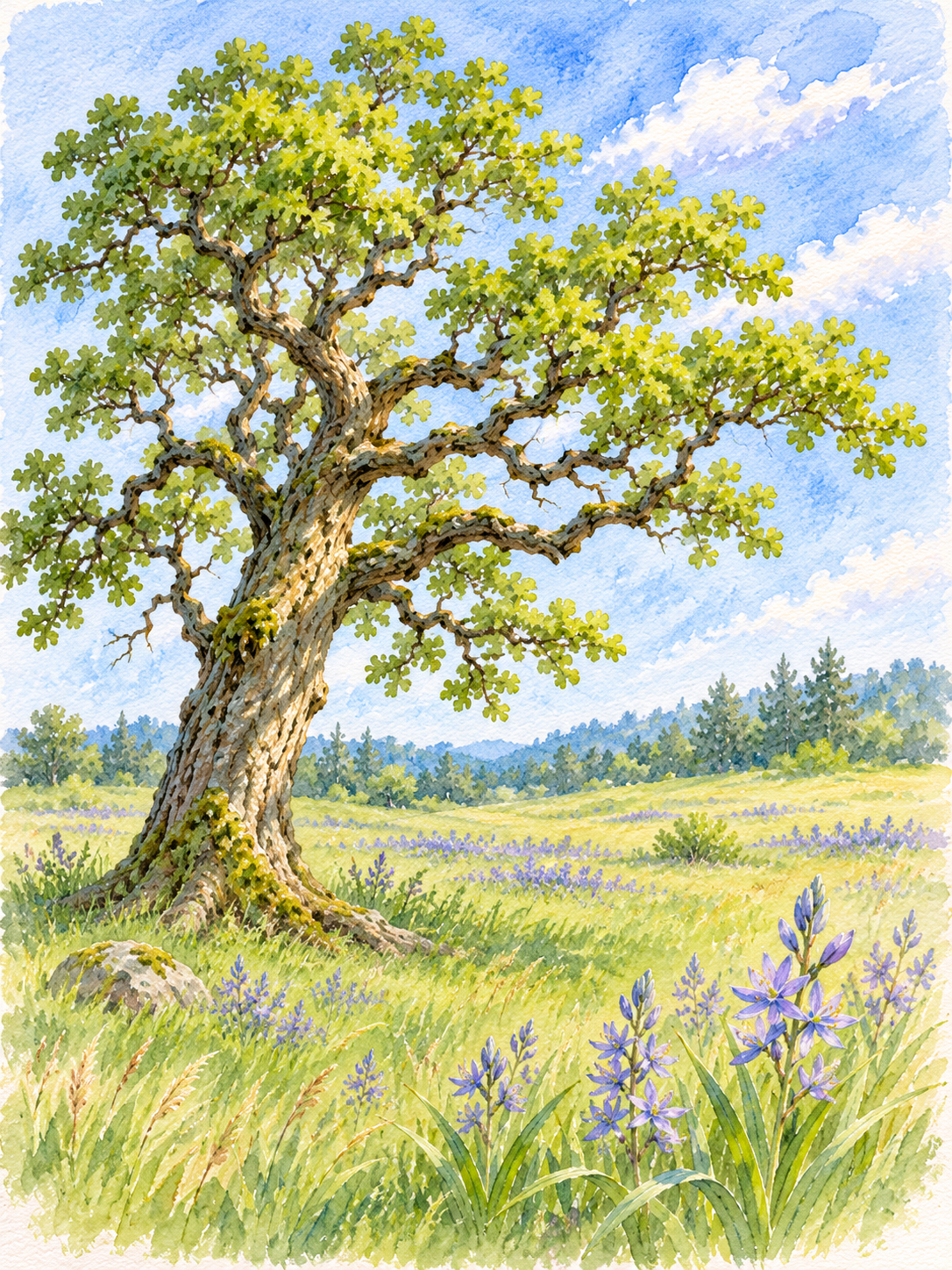
Original watercolour illustration of a mature Garry Oak with twisting branches and a spring meadow of blue-violet wildflowers.
Garry Oak · Original watercolour illustration · BC Watercolour Art

Tree · Artwork No. 02 · Life in a Garry Oak Meadow

Garry Oak

Quercus garryana

With its twisting branches and wide, open crown, Garry Oak is one of the defining trees of southeastern Vancouver Island. Where sunlight reaches the ground between its branches, spring wildflowers, insects, and other wildlife become part of a remarkably rich landscape shaped by nature and generations of Indigenous stewardship. [1–3, 5, 8]

Seasonal changes
Fresh leaves and small flowers in spring; acorns by late summer or fall [2]
Where it grows
Open woodland, dry rocky slopes, grasslands and meadow edges [1]
Found in B.C.
Mainly southeastern Vancouver Island and the Gulf Islands; rare mainland outliers [1]
Plant family
Fagaceae, the beech and oak family [1]

Take a little of the meadow with you

Download the artwork

Enjoy the full original PNG illustration. Free to download and reuse, with no attribution required.

Download watercolour PNG

This permission applies to this original illustration only. Outside photographs and research materials are not included.

A closer look

Field notes beneath the oak

Discover what makes Garry Oak an unmistakable part of the coastal meadow landscape.

01 / Identification

A crown of twisting branches

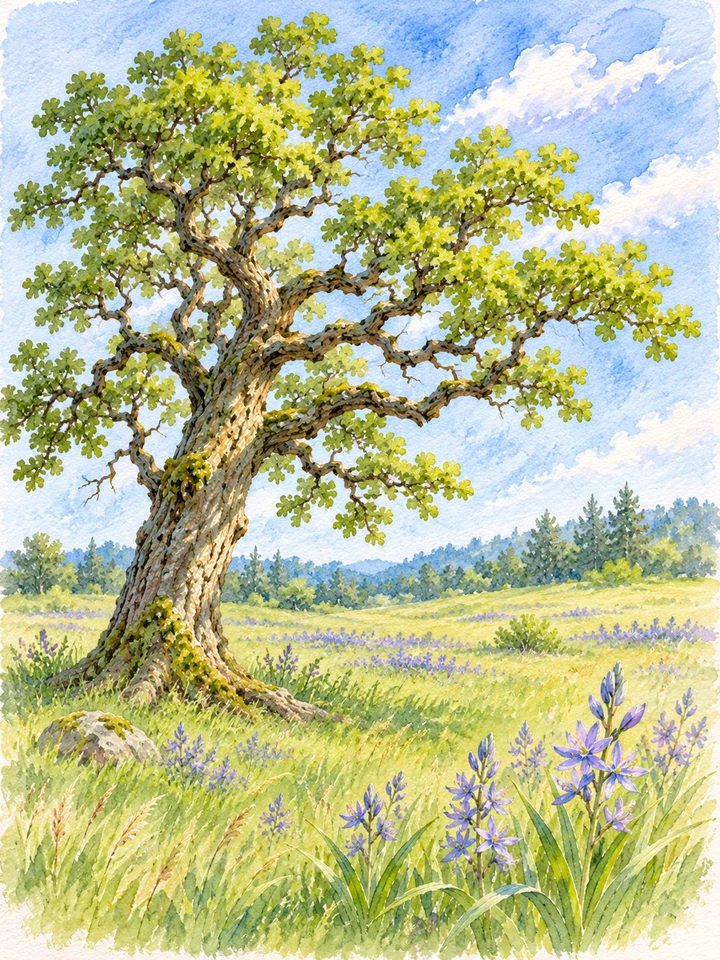
Garry Oak is a deciduous tree, meaning it loses its leaves each year. Mature trees often have stout, craggy trunks and wide crowns. Their leaves have rounded, deep lobes; the bark is pale to dark grey-brown with thick ridges. On exposed rocky sites, a Garry Oak can be much smaller than one growing in deeper soil. [1] [3]

02 / Habitat and range

A tree of the sunny coast

In B.C., Garry Oak grows mainly at low elevations on southeastern Vancouver Island and the Gulf Islands, with a few isolated mainland populations. Its open woodlands occur in dry grasslands, on rocky outcrops and in other well-drained places. The spaces between trees can support colourful spring meadows, though every site is different. [1] [2] [5]

03 / Ecological relationships

Life around the branches

An open oak canopy can create sunlit places for native meadow plants, including camas where conditions are suitable. [5] Garry Oak meadows and woodlands provide varied habitat for plants, insects, birds and other wildlife. Which species occur depends on conditions at each site. [7]

04 / Seasons

From spring catkins to acorns

Small male flowers hang in clusters called catkins as new leaves emerge in spring; tiny female flowers grow on the same tree. Acorns develop through the warmer months and ripen by late summer or fall. The leaves typically turn yellow-brown before dropping, revealing the tree’s sculptural branches in winter. [1] [2]

05 / Living heritage

Meadows shaped by care

Garry Oak landscapes lie within the traditional territories of Coast Salish Peoples, including the lək̓ʷəŋən, W̱SÁNEĆ and Hul’q’umi’num’-speaking Nations. Indigenous stewardship has helped sustain open meadows through practices that vary by community and place, including tending food plants. The W̱SÁNEĆ Leadership Council describes community efforts to reclaim cultural burning as a way of caring for W̱SÁNEĆ territory. These relationships and stewardship practices continue today. [5] [8] [10]

06 / Interesting details

The oak’s smaller surprises

One Garry Oak carries both male and female flowers, but they are small enough to overlook. Its acorns usually mature in a single growing season. And although a well-grown oak can reach about 25 metres in height, a tree rooted in thin, rocky soil may remain surprisingly short. [1] [2]

Further reading

Research & references

Species information and references rechecked on 6 November 2026. This is an original artistic watercolour, not a botanical identification plate.

  1. E-Flora BC · Quercus garryana species account Native identity, family, identification, flowers, acorns, range, and seasonal traits.
  2. Garry Oak Ecosystems Recovery Team · Garry Oak Morphology, soil and landscape setting, flowers and acorn season.
  3. Province of British Columbia · Garry Oak tree compendium Tree form, habitat, and distinction between species conservation and ecological communities.
  4. BC Conservation Data Centre · Garry Oak species summary Provincial Yellow-list status and S5 rank dated April 2019 for Q. garryana var. garryana.
  5. GOERT · What are Garry Oak and associated ecosystems? Meadow ecology and the role of ongoing Indigenous land stewardship.
  6. GOERT · Why are they disappearing? Habitat conversion, fragmentation, invasive species, and fire suppression.
  7. GOERT · Species at Risk Associated biodiversity and the proportion of original habitat in near-natural condition.
  8. GOERT · Territorial Acknowledgement & First Nations Acknowledgement of the Nations and their continuing relationships with these ecosystems.
  9. GOERT · What We Do Recovery activities, native plant restoration, protection and stewardship initiatives.
  10. W̱SÁNEĆ Leadership Council · Youth reclaiming cultural burning Published October 2021. W̱SÁNEĆ community perspectives on reclaiming cultural burning and caring for W̱SÁNEĆ lands.
Back to Life in a Garry Oak MeadowArtwork No. 02 of the collection