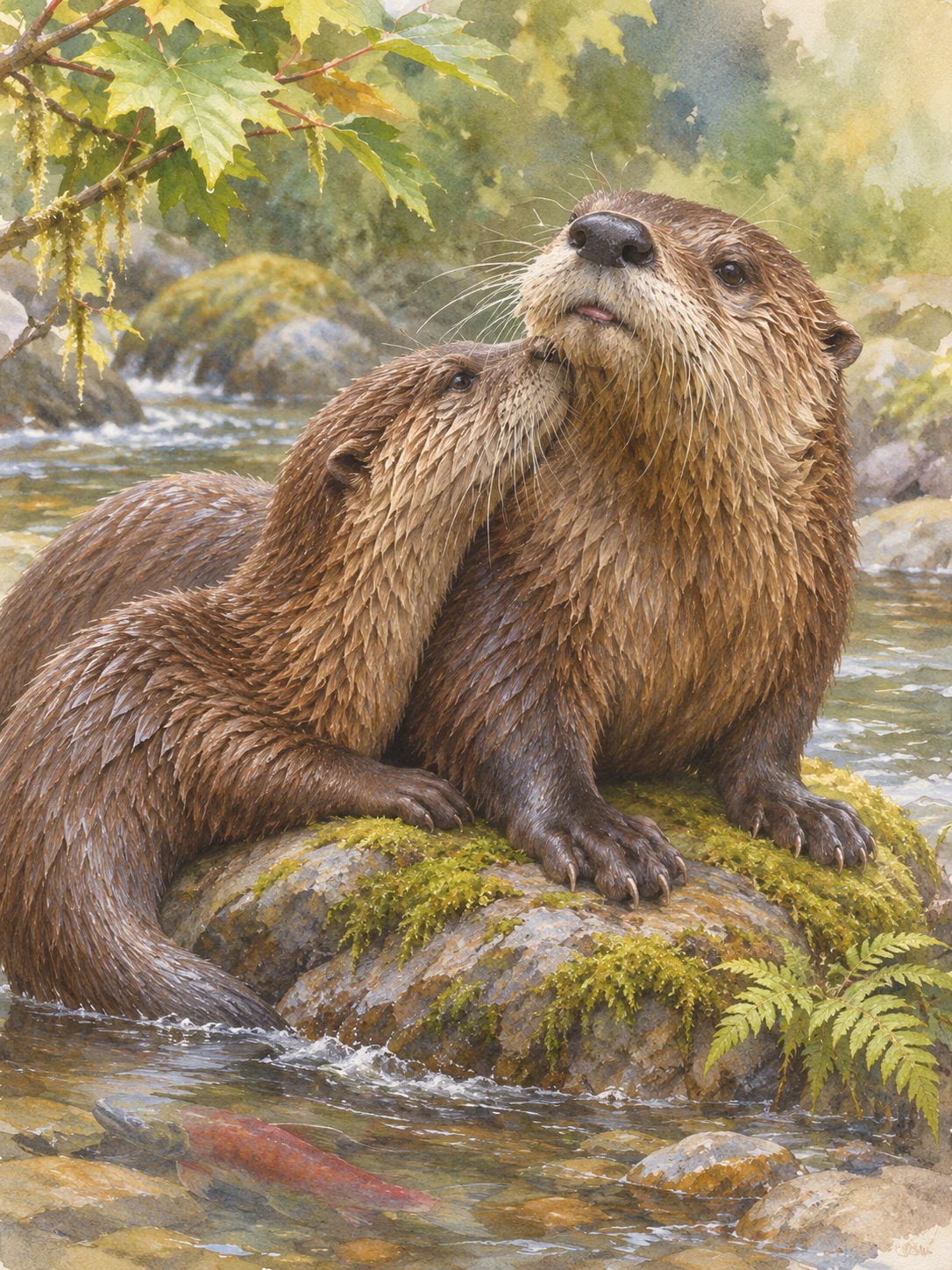
Species at a glance
- Common names
- North American River Otter; River Otter.
- Appearance
- A sleek, elongated dark-brown mammal with small rounded ears, a broad dark nose, pale whiskers and a lighter chin and throat.
- Adult size
- Approximately 100 to 150 cm long, including a thick, tapering tail. Body mass is commonly about 5 to 14 kg.
- BC range
- Widespread in British Columbia, including Vancouver Island, Haida Gwaii, interior watersheds and the mainland coast.
- Food
- Primarily fish, with crabs, crayfish, amphibians and other aquatic prey taken according to habitat and availability.
- Breeding
- Young are commonly born in late winter or spring. Litters often contain two or three kits, although numbers vary.
How to recognize it
A river otter has a long, muscular body, a broad, somewhat flattened head, short sturdy legs and a thick tail that narrows evenly to a point. Its small rounded ears sit low on the head. Long, pale whiskers spread from the muzzle, helping it detect movement and pressure changes in the water. Each foot has five clawed, webbed toes that assist with swimming and gripping slippery surfaces. [3, 4]
Its double coat is another distinguishing feature. Dense underfur insulates the body, while glossy outer guard hairs shed water. Wet fur may appear clumped into pointed strands. The back and sides are usually rich brown, contrasting with a paler throat and muzzle. [3, 4]
Despite their name, river otters regularly use salt water along the BC coast. They are not sea otters. River otters have much longer, tapering tails, travel readily on land and generally swim belly-down. Sea otters are heavier-bodied, have broad flipper-like hind feet and often float on their backs. [3, 5]
Where it lives
North American river otters occur in freshwater and marine-connected landscapes across British Columbia. Along forested rivers they use streambanks, pools, logjams and wetlands. They may shelter in abandoned beaver burrows, hollow logs, spaces beneath roots and natural rock cavities. A reliable food supply and safe places to rest or raise young are important habitat features. [1, 3, 4]
On Vancouver Island and around the Salish Sea, otters also forage in shallow coastal water, kelp beds, bays and intertidal areas. They may travel between a stream and a nearby shore, reminding us that the boundary between freshwater and ocean habitats is not always a boundary for wildlife. [3, 5]
A 2025 study on Protection Island near Nanaimo found that shoreline structure, driftwood, vegetation and access to water helped explain where otters used a partly developed island. Those findings describe the studied island, not a universal rule for every BC shoreline. [6]
A year in the life of a river otter
River otters remain active year-round. They may be most active at dawn, dusk or night, but daytime sightings are common enough, particularly where otters are feeding, travelling or interacting. They swim with an undulating motion and may briefly break the water's surface in a series of low arcs, sometimes called porpoising. On snow or mud, they may alternate bounding steps with belly slides. [3, 4]
Their breeding cycle includes delayed implantation: a fertilized embryo can remain dormant for months before developing further. In many parts of their range, females give birth in late winter or early spring in secluded dens. Kits are born helpless, learn to swim under their mother's care and may remain with her for much of their first year. Timing varies by location. [1, 5]
Otters may be solitary or form social groups. Family members can groom, nuzzle, play and travel together. The pair in this artwork illustrates the species' social contact without claiming to depict a particular observed family or a documented event. [3, 11]
Why River Otters matter
River otters are adaptable aquatic predators. In freshwater they may hunt sculpins, suckers, minnows, trout and other fishes; along the coast, their prey can include nearshore fish and crabs. Their choices depend on local habitat, season and what is available. Salmon and other salmonids can be part of their diet where their ranges overlap. [4, 5, 11]
They also connect water to land. Coastal otters repeatedly use shoreline sites to deposit droppings, known as spraints, along with other scent markings. Fish and marine invertebrates eaten in the water contribute nutrients that are later deposited on land. This can help move aquatic-derived material into shoreline soils and plant communities. [5]
Because otters feed high in aquatic food webs, pollutants such as persistent industrial chemicals and mercury can accumulate in their tissues. Studies of marine-foraging otters on southern Vancouver Island have explored their value as indicators of contamination. Their presence alone, however, is not proof that a stream is unpolluted. [7]
First Nations relationships and watershed stewardship
River otters move through watersheds and coastlines within the traditional territories of many First Nations. Healthy rivers, intact shorelines and abundant fish are part of landscapes stewarded by Indigenous peoples in British Columbia. This general profile does not attribute specific otter stories, cultural names or harvesting practices to an individual Nation without a verified Nation-specific source.
Visitors can support respectful stewardship by following local First Nations and land-manager guidance, protecting riparian vegetation and leaving shorelines and wildlife undisturbed.
Conservation: widespread does not mean free from threats
The BC Conservation Data Centre ranks Lontra canadensis as S5 (Secure) and places it on the provincial Yellow List. Its status was last reviewed on 14 March 2025. The global species rank is G5 (Secure). These are conservation ranks, not a guarantee that every local group is thriving. [1, 2]
Environment and Climate Change Canada has described the species as widespread in Canada and regulated as a furbearer by provinces and territories. River otters are covered by CITES Appendix II for international trade. No COSEWIC assessment was identified in the reviewed federal material, and the species is not listed under the federal Species at Risk Act. A blank COSEWIC field in a provincial database should not be read as a formal 'Not at Risk' assessment. [1, 10]
Local pressures can include loss of streamside cover, declining water quality, pollution and oil spills, accidental capture in fishing equipment, collisions with vehicles and human disturbance near den sites. Keeping connected wetlands, healthy fish populations and sheltered shorelines benefits both otters and the wider ecosystem. [2, 4, 7, 8]
Five details worth noticing
- The long, tapering tail helps steer and propel the otter through water. Unlike a sea otter, it has no short, paddle-like tail. [3, 4]
- Even in sheltered coastal bays, the otter you see swimming or climbing ashore may be a river otter, not a sea otter. [3, 5]
- Sensitive whiskers help an otter detect moving prey in murky water and among underwater rocks. [4]
- River otters sometimes slide on snow or mud and use repeated shoreline scent-marking locations called latrines. [3, 5]
- Otters can carry nutrients from fish-rich waters onto the land when they leave spraints and prey remains along the shore. [5]
A respectful way to watch river otters
Enjoy otters from a distance using binoculars or a camera zoom. Never feed, approach, chase or corner them. Keep dogs leashed near shorelines, give mothers and kits extra room, and avoid investigating den entrances or latrine sites. If an otter is using a dock or space beneath a building, follow humane exclusion advice rather than trapping or sealing an occupied den. The BC SPCA provides guidance and operates an Animal Helpline at 1-855-622-7722. [5, 8]
A quiet observation from an established trail or shoreline viewing area is usually a better encounter for both people and otters.