Species at a glance
- Common names
- Red Alder; Oregon Alder; Western Alder.
- Tree type
- Native deciduous broadleaf tree and fast-growing pioneer.
- Height
- Often up to about 25 m; occasionally taller on highly productive sites.
- Identification
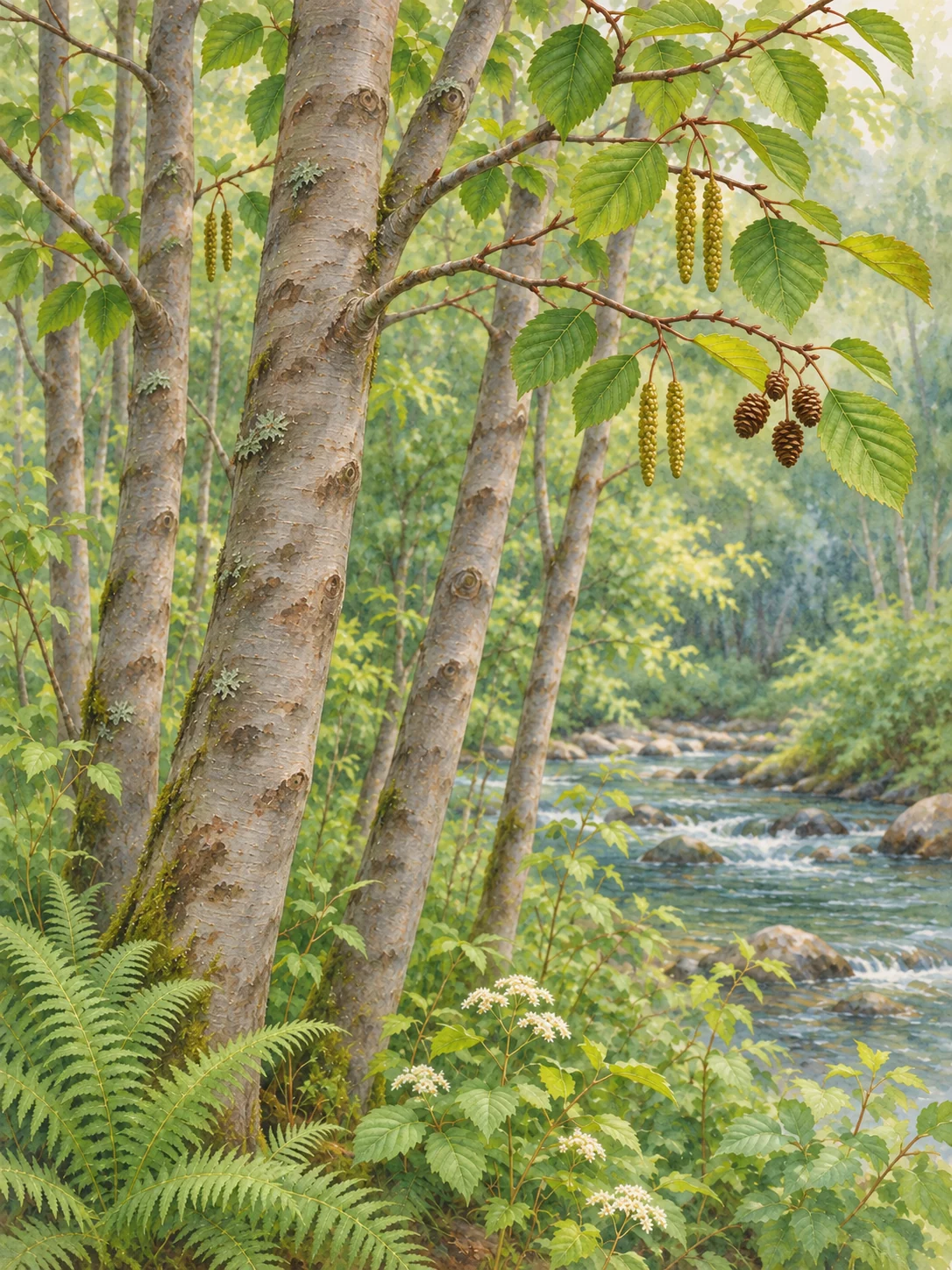
- Smooth pale-grey bark, often lichen-mottled; oval, double-toothed leaves with slightly rolled-under margins; hanging pollen catkins and small woody, cone-like seed structures.
- BC range
- Throughout coastal BC, including Vancouver Island and Haida Gwaii, and inland along some major river valleys.
- Season
- Male catkins open before or around leaf-out in late winter to early spring; seeds ripen in autumn and may be released through winter.
How to recognize it
Look first at the bark. Young Red Alders have smooth grey to greenish-grey trunks. Mature trees often appear pale and patchy because their bark supports crustose lichens and moss. The name ‘red’ does not describe the tree’s leaves: exposed inner bark and cut wood can turn a vivid rusty-orange or reddish colour. [1, 2]
Its alternate leaves are simple and oval to somewhat diamond-shaped, with pointed tips and prominent side veins. The margins are coarsely double-toothed and usually roll slightly under, a particularly useful feature for distinguishing Red Alder from some other native alders. [1, 2]
On bare branches, look for clusters of hanging male pollen catkins and small, dark, woody structures that resemble miniature cones. These 1.5 to 2.5 cm structures develop from female catkins and can persist through winter. They are not conifer cones. [1, 2]
Where it grows
Red Alder thrives in BC’s coastal forests, along streams and floodplains, and on disturbed ground where sunlight reaches exposed soil. It is especially common in the Coastal Western Hemlock and Coastal Douglas-fir biogeoclimatic zones. [2, 3]
It is a pioneer tree, often establishing after floods, landslides, harvesting or other disturbances. Although a mature alder canopy produces shade, seedlings need strong light. Red Alder can form young stands of its own or grow alongside black cottonwood, Douglas-fir, western redcedar and other coastal trees. [1, 3]
On southeastern Vancouver Island and the Gulf Islands, alder-lined moist channels sometimes occur near drier Garry Oak landscapes. That is a contrast in habitats, not a suggestion that both trees occupy identical soil and moisture conditions. [2, 3]
The tree through the seasons
Late winter and spring: Long, dangling male catkins release wind-borne pollen before the canopy fills. Small female catkins develop on the same tree, and fresh leaves unfold. [1, 2]
Summer: Green leaves form a canopy over damp ground and, where branches overhang water, provide stream shade. Developing seed structures mature as the season progresses. [1, 3]
Autumn: Small winged seeds mature in woody cones. Leaves often drop while still green or after turning a dull yellow-brown rather than a brilliant red. Fallen leaves begin breaking down on land and in water. [1, 2, 5]
Winter: Bare twigs display persistent cones and compact clusters of catkins. Rain and floodwater move fallen leaves and small branches through pools and riffles. [1, 5]
Why Red Alder matters: the forest feeds the stream
Red Alder has an unusual partnership below ground. Its roots form nodules containing Frankia, nitrogen-fixing bacteria that transform atmospheric nitrogen into usable forms. As roots and nitrogen-rich leaves decompose, some of this nitrogen reaches forest soil, influencing the conditions in which other plants grow. Fixation and soil effects vary from site to site. [3]
Along streams, alder roots can help hold soil in place and reduce bank erosion. Branches and leaves provide shade, which may moderate solar heating in small channels. Actual stream temperature depends on flow, weather, channel width and the surrounding vegetation. Fallen wood can also contribute physical cover and structure. [1, 3, 7]
The relationship continues beneath the water. Alder leaves are relatively nitrogen-rich and decompose readily. Microbes and aquatic invertebrates help process them, moving organic material into stream food webs. Studies in Washington and southeastern Alaska document nutrient and invertebrate effects associated with Red Alder. These findings describe a wider Pacific Northwest mechanism, not a measured response in every BC stream. [5, 6]
Young Coho Salmon and Steelhead Trout feed on aquatic insects, including some caddisfly larvae. Alder is therefore part of a larger relationship linking streamside forest, invertebrates and juvenile fish. Not every caddisfly species eats alder leaves, and not every salmon stream is lined with Red Alder. [5, 6]
First Nations relationships and stewardship
Red Alder grows within the territories of many First Nations across coastal British Columbia. Knowledge, uses and responsibilities connected to this tree differ by Nation and place. Published regional accounts describe Coast Salish uses of alder bark for dyes, workable wood for bowls and implements, and alder wood as fuel for smoking fish. These examples should not be treated as identical practices across all communities. [8, 9]
Healthy streams and forests depend on place-specific care. Where this website discusses a particular Nation’s teachings or cultural uses, those details should be guided by that Nation’s own public sources and wishes rather than by broad third-party summaries. [8, 9]
Conservation: a secure tree, with vulnerable communities
The BC Conservation Data Centre lists Alnus rubra on the Yellow List with a provincial S5 (Secure) rank dated April 2019 and a global G5 (Secure) rank dated September 2015. Its species summary contains no COSEWIC status or Species at Risk Act schedule entry. A blank assessment field must not be rewritten as an official ‘Not at Risk’ assessment. [4]
Some ecological communities containing Red Alder face greater conservation concern than the tree itself. The red alder / slough sedge [black cottonwood] community is Red-listed and ranked S2 in BC; the red alder / salmonberry / common horsetail community is Blue-listed and ranked S3. These rankings describe different ecological communities, not the species Red Alder. [10, 11]
Streamside development, altered drainage, vegetation removal and degraded banks can damage riparian habitats. Protecting connected stream corridors, retaining native vegetation and planning site-appropriate restoration help conserve the functions of alder stands alongside other streamside species. [3, 7]
Five details worth noticing
- Its name comes from the orange-red colour that can develop in exposed inner bark or wood, not from bright red autumn leaves. [1]
- Its leaves have prominent ladder-like veins and double-toothed margins that curl slightly under. [1, 2]
- Those little woody ‘cones’ are mature female catkins, not the cones of a conifer. [1, 2]
- The nitrogen-fixing partner in Red Alder root nodules is a group of bacteria called Frankia. [3]
- Leaf litter can help nourish aquatic decomposers and invertebrates, connecting forest vegetation with stream food webs. [5, 6]
A respectful way to observe Red Alder
Look for pale, lichen-flecked trunks beside moist forest paths and streams. Without leaving a trail, compare the leaves, bark and woody cones. Avoid scratching or peeling live bark just to see the red colour, and do not damage branches. Stay off unstable streambanks and spawning gravel, and respect local conservation and First Nations guidance.