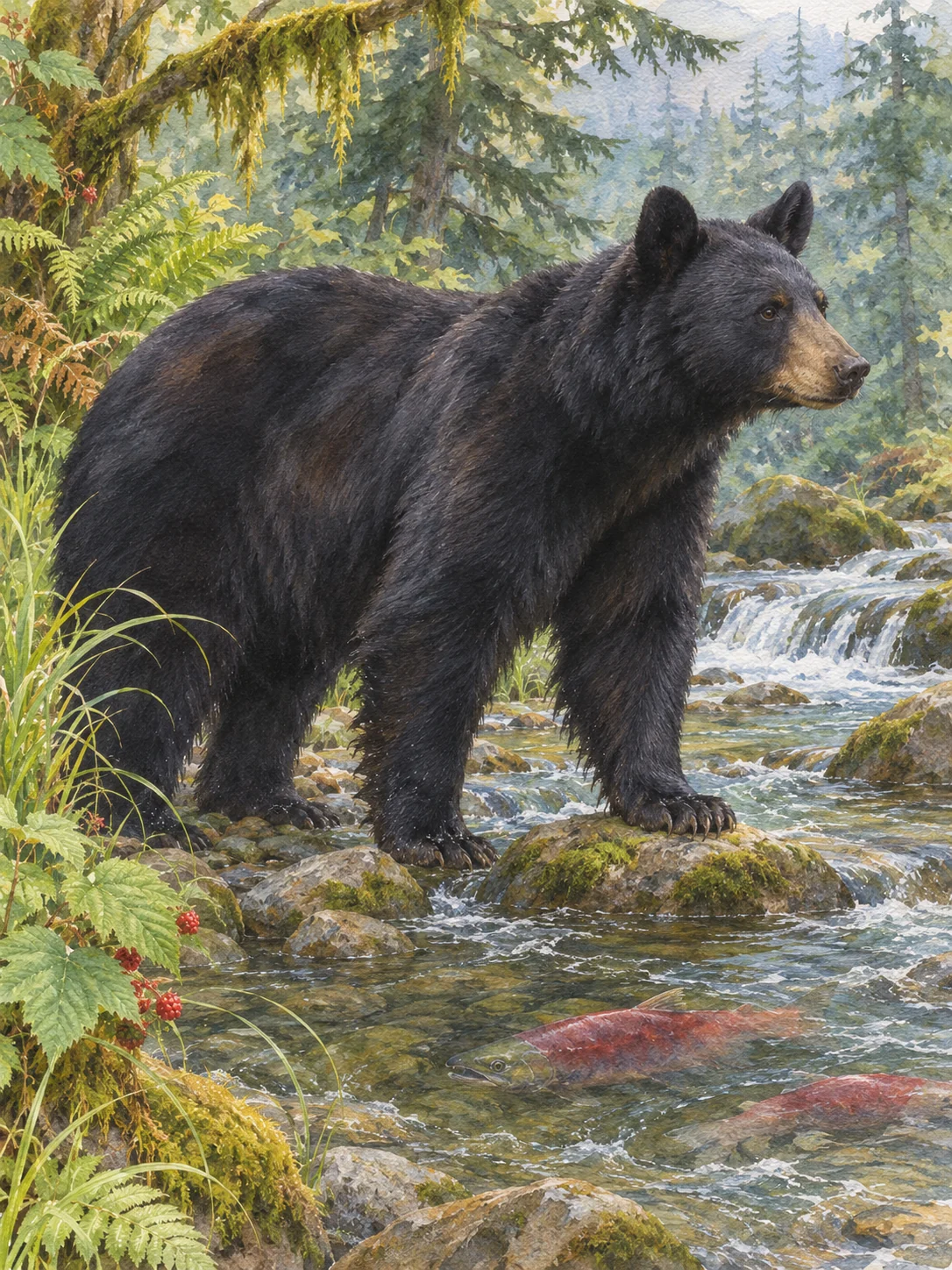
Species at a glance
- Common names
- American Black Bear; Black Bear
- Appearance
- A sturdy, short-tailed bear with upright ears, a straight or slightly convex muzzle, and no prominent shoulder hump. Its coat may be black, brown, cinnamon, blonde or, in the Kermode form, cream-white.
- Size
- Head and body commonly about 1.5 to 1.8 m long; adults vary greatly in mass, and males generally grow larger than females.
- BC range
- Widespread throughout British Columbia, including Vancouver Island and Haida Gwaii.
- Food
- An adaptable omnivore. Green plants and berries make up much of the diet; insects, carrion and salmon are important foods where available.
- Season
- Generally most active from spring through autumn, with winter denning that varies by region, food availability, weather and sex.
How to recognize it
Despite its name, an American Black Bear is not always black. Across BC, individuals may have black, dark brown, reddish-brown or cinnamon fur, and pale colour phases also occur. A tan or grizzled muzzle is common. The rare cream-white Kermode or Spirit Bear is a colour form of the American Black Bear, not an albino and not a separate bear species. [1, 3, 8]
Shape is a more useful clue than colour alone. Black Bears usually have relatively tall, pointed ears, a straight or gently convex facial profile, a back without the pronounced shoulder hump typical of a Grizzly Bear, and shorter, more curved claws. Both species vary in size and colour, so several features should be considered together. [1, 3, 4]
Tracks usually show five toes, a broad foot pad and claw marks close to the toes when the ground preserves them. Black Bears can climb trees exceptionally well, but a track, glimpse of fur or estimate of body size by itself is not a reliable species identification. [3, 4]
Where it lives
Black Bears inhabit a remarkable range of British Columbia landscapes. They occur in coastal western hemlock forests, the forests of Vancouver Island and Haida Gwaii, interior mountains and valleys, wet meadows, estuaries and shrubby openings. They also travel through the edges of communities where forest and human settlement meet. [1, 2, 4]
In salmon-bearing watersheds, streams and riverbanks can offer seasonally rich feeding opportunities. Not every Black Bear fishes, and not every stream has an accessible salmon run. The value of a particular corridor depends on its fish, plant foods, cover and seasonal conditions. [3, 5]
Mature coastal trees, large logs, stumps and root structures can also provide winter dens. A provincial wildlife report identifies the loss of large-den structures through forest harvesting as a potential local concern, particularly on Vancouver Island. [2, 4, 10]
The bear through the seasons
Spring: After leaving their dens, bears seek tender green plants such as sedges, grasses and skunk cabbage. Along the coast, they may forage in wet meadows, estuaries and forest openings. Cubs born in winter emerge with their mothers when conditions permit. [3, 4]
Summer: Berries, insects, roots and other seasonal foods become important. Breeding generally occurs in June and July. Female bears have delayed implantation, meaning a fertilized embryo does not begin its main development immediately after mating. [1, 3, 4]
Autumn: Bears enter hyperphagia, a period of intense feeding as they build fat reserves before winter. Along salmon-bearing rivers, spawning fish can be a valuable, energy-rich food source, although timing and access differ among watersheds. [3, 4, 8]
Winter: Many Black Bears retreat to dens and reduce their activity and metabolism. Winter dormancy is generally shorter on BC's milder southern coast than in colder interior and northern regions. Mothers commonly give birth in January or February while denning, and cubs remain dependent on them well beyond their first spring. [1, 4, 10]
Why Black Bears matter: salmon nutrients reach the forest
The Salmon Streams collection follows a connection that is easy to miss. Salmon grow in the ocean, return to freshwater to reproduce, and bring marine-derived nutrients back with them. Black Bears are one of the animals that can move this food and its nutrients beyond the water's edge. [5, 6]
A particularly clear example comes from fieldwork on Haida Gwaii by University of Victoria researcher Thomas Reimchen. In a studied watershed, Black Bears carried thousands of Chum Salmon into the streamside forest during a spawning run. The remains were then eaten by crows, blowfly larvae and other scavengers, distributing the benefits of the salmon run through a much wider food web. This was a documented local study, not a province-wide rate for all salmon streams. [5]
Research from another Haida Gwaii salmon stream has also linked where bears deposited salmon carcasses with marine-nitrogen signals and growth patterns in nearby Sitka spruce. These findings show how a river can influence forest life, while allowing for substantial differences between streams, years and ecosystems. [6]
Bears are important in other ways too. As omnivores, they consume plants, berries, insects and animal foods, and they participate in the movement of seeds and nutrients across forest habitats. Their ecology cannot be reduced to salmon alone. [3, 4]
First Nations relationships and stewardship
Black Bears and salmon live within the territories of many First Nations whose relationships with these lands and waters continue today. Wildlife, food systems and habitat stewardship are place-specific. Rather than attributing a single set of teachings to all Nations, this profile focuses on publicly documented ecological relationships. [8]
On the Central Coast, the Kitasoo Xai'xais Nation operates Spirit Bear Lodge and shares information about Black Bears, Spirit Bears and the rainforest within its territory. The Nation's wildlife-viewing approach emphasizes observing animals respectfully and with minimal disturbance. The pale Kermode form is especially associated with parts of the Central and North Coast; its cultural significance should be described using the relevant Nations' own sources and words. [8]
Conservation: secure provincially, but not free from risk
The BC Conservation Data Centre lists Ursus americanus on the Yellow List, with a provincial conservation rank of S5 (Secure), last reviewed on 9 April 2025. Its global rank is G5 (Secure), dated April 2016. COSEWIC assessed the species as Not at Risk in May 1999. The provincial species summary does not show a federal Species at Risk Act schedule listing. These are different assessment systems and should not be treated as interchangeable. [1, 2]
A secure provincial rank does not mean every bear or local habitat is safe. In developed areas, accessible garbage, fruit, pet food, birdseed and other human-provided foods may attract bears and lead to repeated conflicts. Food-conditioned bears can lose their natural wariness, creating risks for people and for the bears themselves. [3, 7, 9]
On the coast, protecting large trees and other suitable winter-den structures is another stewardship issue. BC's conservation-status review identifies den habitat loss associated with forest harvesting as a concern that has not been fully quantified across the province. Healthy salmon streams, connected forest habitat and careful management of attractants all help keep Black Bears wild. [2, 10]
Five details worth noticing
- A brown or cinnamon bear can still be an American Black Bear. Fur colour alone does not distinguish it from a Grizzly Bear. [1, 3]
- Taller ears, a relatively straight muzzle, shorter curved claws and the absence of a prominent shoulder hump are useful identification clues when considered together. [3, 4]
- The cream-white Spirit Bear is a rare colour form of the American Black Bear associated with parts of BC's Central and North Coast. [1, 8]
- Mothers commonly give birth while denning in midwinter, when the cubs are tiny and entirely dependent on them. [1, 4]
- In a documented Haida Gwaii watershed, Black Bears carried thousands of spawning Chum Salmon into the forest, where crows and invertebrates consumed the remains. [5]
A respectful way to observe Black Bears
Watch from a safe distance and never approach or feed a bear. BC Parks recommends staying at least 100 m from predators such as bears when viewing wildlife. Use binoculars or a telephoto lens instead of moving closer, and give extra space to any bear feeding on fish or accompanied by cubs. [7]
Around salmon streams, rushing water can mask the sound of people approaching. Make your presence known when travelling through poor-visibility areas, keep dogs leashed and carry accessible bear spray that you know how to use. If you encounter a bear, do not run. Stay calm, assess its behaviour, speak calmly and back away slowly when safe, following current BC Parks and WildSafeBC advice. Specific responses depend on the bear's behaviour and the situation. [3, 7]
At home, store garbage and food scraps securely, pick ripe fruit promptly, and keep pet food and other attractants inaccessible. Report concerning bear behaviour to the BC Conservation Officer Service at 1-877-952-7277. A bear left undisturbed and without access to human food has a better chance to remain wild. [3, 7, 9]