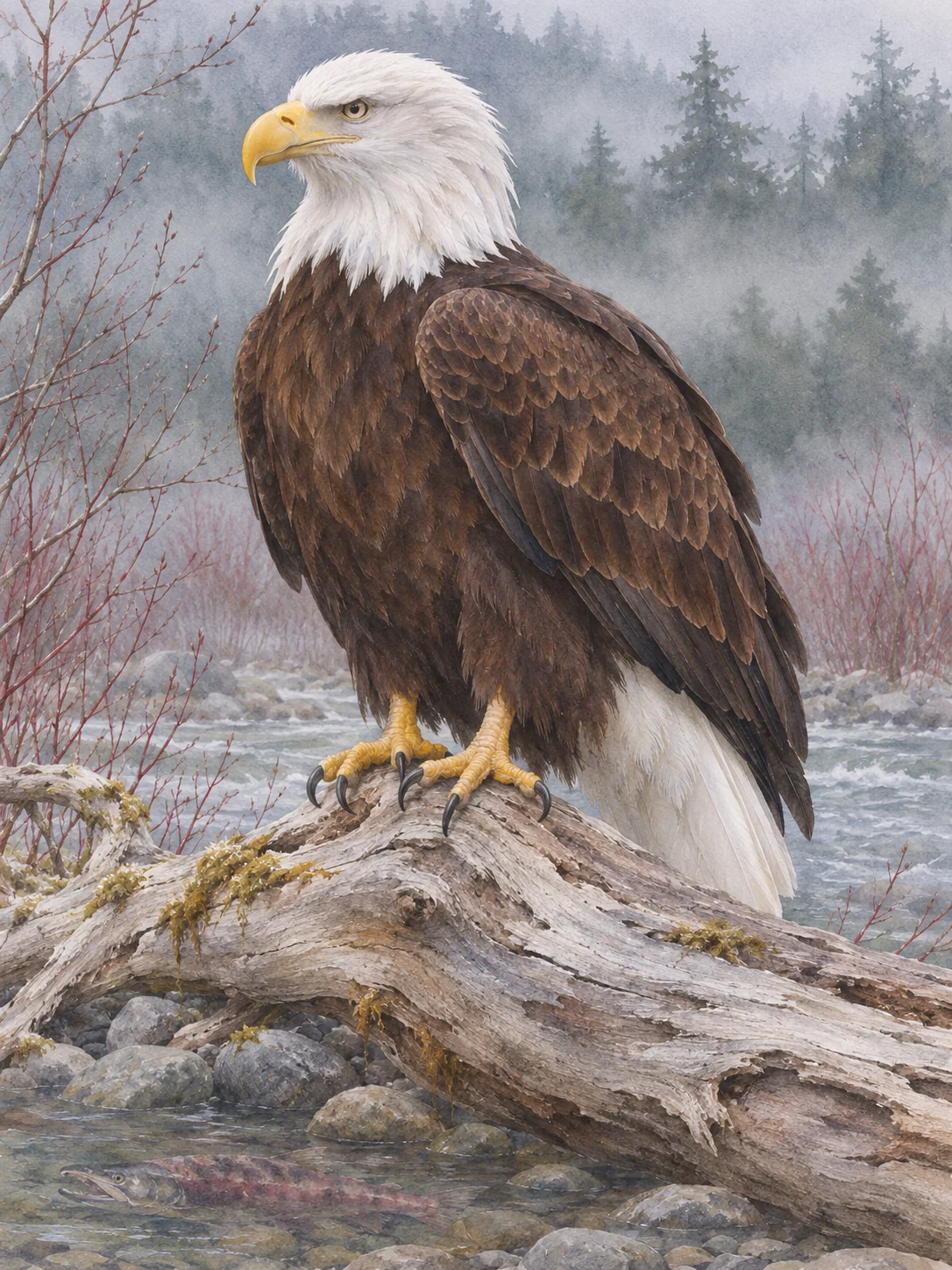
Species at a glance
- Common names
- Bald Eagle; Pygargue à tête blanche (French).
- Adult size
- Approximately 79–94 cm long, with a wingspan of 178–229 cm. Females are generally larger than males. [1, 8]
- Appearance
- A dark chocolate-brown body and wings, white head and tail, heavy yellow hooked bill, pale yellow eyes and unfeathered yellow lower legs.
- Identification
- Adult white head and tail; broad, flat wings with fingered tips when soaring. Immature birds are mottled brown and can look very different. [1, 8]
- BC range
- Breeds across British Columbia, especially along the coast and on wooded lakeshores and rivers. Many coastal birds remain year-round; some northern and interior birds move seasonally. [1, 2]
- Food
- Live fish, spawned-out salmon, waterbirds, small mammals and carrion. Bald Eagles also sometimes steal food from other birds. [2, 8]
- Breeding season
- In coastal BC, nest repair often begins in January or February; eggs are commonly laid from late February through April. [3]
- Winter salmon season
- Many notable BC river gatherings occur from October through January, with local timing driven by salmon availability and river conditions. [4, 6]
How to recognize it
An adult Bald Eagle is unmistakable when seen well: a broad brown body below a white head and neck, a white tail, and a large yellow bill curved sharply downward. Its yellow feet end in thick black talons. In flight, the eagle often holds its long, broad wings nearly level, with separated primary feathers resembling fingers at each tip. [1, 8]
Young Bald Eagles do not immediately have the familiar white crown. Juveniles are mostly brown with irregular pale patches, dark bills and brownish eyes. Their plumage changes over several years, typically reaching the full white-headed adult appearance at roughly five years of age. A mottled young Bald Eagle can therefore be mistaken for an entirely different species. [1, 8]
One useful comparison is the Golden Eagle, which has feathers down its lower legs to the toes, unlike the Bald Eagle's bare yellow lower legs. An Osprey is smaller and slimmer, with pale underparts and a distinct dark stripe through the eye. Shape, size, plumage and habitat are more reliable together than any single feature. [3, 8]
Where it lives
Bald Eagles nest in every British Columbia ecoprovince, but their greatest breeding concentrations are associated with the coast, including the Strait of Georgia, Vancouver Island, the Gulf Islands, Haida Gwaii and the mainland shore. Inland, they favour forested rivers and lakes where food and suitable nesting trees are available. [1, 2]
A pair may build a huge stick nest high in a sturdy Douglas-fir, Sitka spruce, western redcedar or black cottonwood. These nests can be reused and enlarged over many seasons. Tall, strong trees close to water provide an elevated nest site and clear approaches for flight, while sheltered conifer stands may serve as winter resting places. [2, 3]
During autumn and winter, salmon-bearing rivers become especially important. Eagles assemble along gravel bars, river mouths and forested banks where carcasses are exposed or accessible. Well-known places include the Squamish and Cheakamus rivers, the Harrison and Chehalis watershed, and Vancouver Island streams such as Goldstream and the Englishman River. These are examples of regional habitat, not guarantees of large gatherings on any given day. [4, 6]
A year between coast, nest and river
Winter and early spring: Along much of the coast, established pairs may remain near their nesting territories. Nest building or repair often begins in January and February, with egg laying commonly from late February into April. A clutch usually has one to three eggs, most often two. Both parents incubate them for roughly five weeks. [1, 3]
Late spring and summer: Adults feed the nestlings and guard the nest. Young eagles make their first flights at about 10 to 12 weeks, although they continue to depend on their parents for a time afterward. The chicks are brown rather than white-headed; their distinctive adult plumage takes several years to develop. [1, 8]
Autumn and early winter: As Pacific salmon return to spawn and die, eagles may shift toward productive river corridors. Coastal residents can be joined by birds from interior and northern regions. These seasonal gatherings follow the timing, quantity and accessibility of salmon, so counts can change markedly from year to year. [4, 6, 7]
Why Bald Eagles matter
Bald Eagles are predators, scavengers and sometimes food thieves. They catch fish, take waterbirds or smaller animals, feed on carrion and occasionally force Ospreys or gulls to surrender a catch. That flexibility helps them use many different shorelines and waterways. [2, 8]
Along salmon rivers, spawned-out fish are a major seasonal food source. A 2021 study of four spawning rivers on Vancouver Island found that the timing and distribution of Bald Eagles tracked the availability of salmon carcasses. Accessible gravel bars and mudflats also influenced where eagles concentrated. This was a measured relationship in those studied rivers, not a fixed rule for every river in BC. [6]
When an eagle drags salmon remains from the water onto a gravel bar or into the trees, it can help carry ocean-derived nutrients into the streamside environment. Other scavengers, such as ravens, crows and gulls, may feed on the remains as well. This makes the Bald Eagle part of the larger connection between marine fish, freshwater rivers and coastal forest food webs. [6, 7]
A British Columbia story: Brackendale's winter eagles
Near Squamish, spawning salmon attract wintering Bald Eagles to a broad river valley backed by coastal mountains. The Brackendale Winter Eagle Count recorded 3,769 Bald Eagles in 1994, a celebrated single-day count. Numbers have varied greatly since then, reflecting differences in salmon runs, river flow, weather and where birds gather. The historic record should not be mistaken for a typical annual total. [4]
Brackendale Eagles Provincial Park helps protect part of this winter habitat. Recreational access is restricted from October 1 through March 31, and BC Parks directs visitors to watch from established viewing facilities outside the park, including the Eagle Run dyke across the river. The spectacle is most meaningful when the birds can feed and rest undisturbed. [4]
First Nations relationships and stewardship
The salmon rivers of British Columbia flow through the territories of many First Nations. Their relationships with eagles, salmon and waterways are distinct, rooted in specific places, languages, histories and ongoing stewardship. This page does not treat those relationships as a single shared tradition.
In Sḵwx̱wú7mesh Sníchim, the Squamish language, the Bald Eagle is known as Sp’ákw’us. The name is reflected in Sp’akw’us Feather Park on the Squamish waterfront, a project connected with Squamish Nation culture and local stewardship. Along the Harrison and Chehalis rivers, the lands and waters are in Sts’ailes territory. These are living territories, not simply wildlife-viewing destinations. [9, 10]
Indigenous leadership and stewardship remain essential to protecting salmon habitats and the forests, estuaries and rivers that sustain eagles. Detailed teachings and cultural interpretations should be presented through the relevant Nation's own published materials or with its guidance.
Conservation: a successful recovery, with continuing responsibilities
The Bald Eagle is a major North American conservation recovery story. Populations declined sharply in parts of its range during the twentieth century through persecution and pesticides such as DDT, which impaired breeding success. Legal protections and the reduction of persistent pesticides helped populations recover. British Columbia remains an important stronghold. [2, 8]
The BC Conservation Data Centre lists Haliaeetus leucocephalus on the Yellow List with provincial ranks S5B and S5N, meaning Secure for breeding and non-breeding occurrences; these ranks were last reviewed in March 2015. COSEWIC assessed the species as Not at Risk in May 1984. Those are conservation assessments, not exemptions from wildlife law, and the species is not listed on Schedule 1 of the federal Species at Risk Act. [1]
In BC, section 34 of the Wildlife Act protects birds and their eggs, subject to regulatory exceptions. It also specifically protects eagle nests, whether or not they are occupied. Protection of the nest does not depend on the bird being classified as threatened or endangered. The wording and any applicable authorizations should be checked against current law for a particular activity. [5]
Local pressures remain, including loss of nesting and winter-roost trees, disturbance near active feeding areas, collisions, and poisoning from lead or rodenticides. Salmon availability matters too: if fewer carcasses are available at a particular river, wintering eagles may move elsewhere or have less food. A secure overall rank does not mean every nesting territory or winter gathering is free of risk. [3, 6, 7]
Five details worth noticing
- The word “bald” refers to the adult bird's white head, not a lack of feathers. [10]
- A young Bald Eagle can spend nearly five years in changing brown and white plumage before it looks like the adult illustrated here. [1, 8]
- Tiny rough projections on its feet help grip slippery prey, while heavy curved talons provide a powerful hold. [8, 11]
- On Vancouver Island, researchers documented more eagles where spawned-out salmon were available, especially where river features made carcasses accessible. [6]
- Brackendale's historic 1994 count of 3,769 eagles reflects one exceptional winter, not a predictable number each season. [4]
A respectful way to watch Bald Eagles
Watch from established trails, dykes, boardwalks or viewpoints. Use binoculars or a telephoto lens instead of approaching feeding birds or nest trees. Stay off gravel bars where eagles are resting or feeding, keep dogs leashed and never fly drones close to birds. In winter, unnecessary flight costs energy that birds need to conserve. Follow BC Parks notices, seasonal closures and the guidance of the Nations whose territories you are visiting. [3, 4]