Species at a glance
- Common names
- Steelhead Trout; Steelhead. Also described as sea-run Rainbow Trout.
- Life-history form
- Anadromous, meaning it grows at sea and returns to freshwater to reproduce. Steelhead and resident Rainbow Trout are the same species.
- Appearance
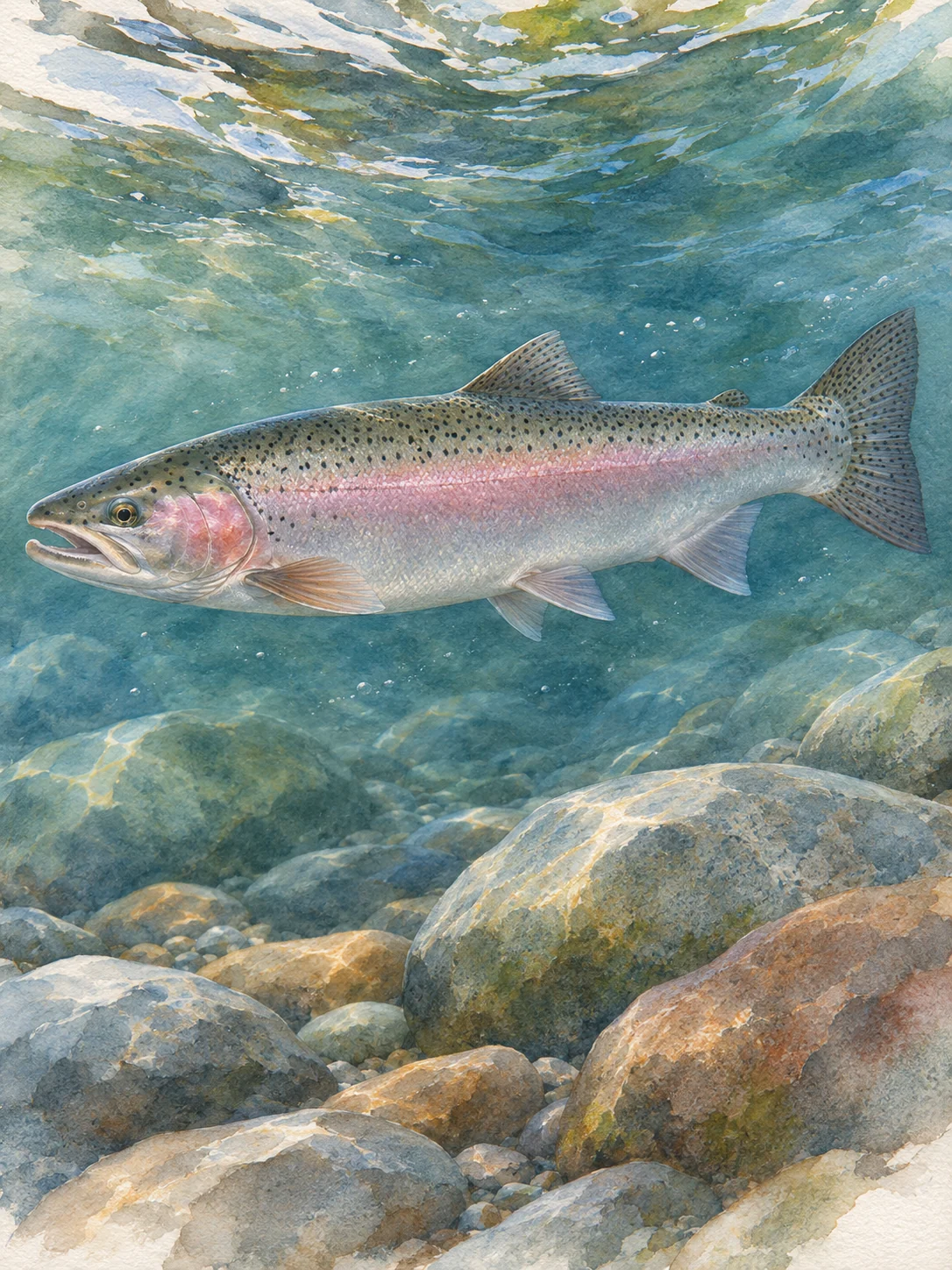
- Streamlined silver body, steel-blue to olive back, fine dark spots and a pink or rosy side band that may become stronger in freshwater.
- Adult size
- Commonly about 50 to 85 cm long and 1.4 to 6.8 kg in BC, although some fish grow much larger.
- BC range
- Coastal and interior watersheds, including Vancouver Island, Haida Gwaii, the Skeena, Nass and Fraser river systems.
- Season
- Summer-run fish enter rivers months before spawning; winter-run fish generally enter closer to spawning. Both usually spawn in spring, with timing varying by river.
How to recognize it
At sea, an adult steelhead can look almost chrome-bright, with silvery flanks, a darker steel-blue or olive back and a pale belly. Small black spots are scattered across its back and dorsal fin and typically reach both the upper and lower lobes of a broad, nearly square tail. After time in freshwater, a distinct rose-pink band may develop along the sides and gill covers. [2, 5]
Steelhead can resemble Coho Salmon, but Coho usually have spots concentrated on the upper half of the tail, while steelhead are often spotted across both halves. Unlike Chinook Salmon, steelhead generally have pale gums rather than black lower gums. Colour and markings vary with maturity and season, so several features should be considered together. [2, 4, 5]
Where it lives
Steelhead occur in a wide range of British Columbia watersheds, from Vancouver Island and the mainland coast to the Skeena, Nass and Fraser river systems. The Thompson and Chilcotin populations make especially long migrations between interior spawning tributaries and the ocean. Other populations return to shorter coastal rivers. [1, 4]
Young steelhead need access to a mix of riffles, pools, gravel, boulders and streamside shelter. Shaded banks and fallen wood help maintain cooler water and create places to escape strong flows or predators. Depending on the watershed and season, adults may rest in deep, cool pools before moving to spring spawning grounds. [2, 4, 8]
A life between river and sea
In spring, a female uses her tail to make a shallow nest, called a redd, in clean, oxygenated gravel. Eggs develop beneath the stones. After hatching and absorbing their yolk sacs, young steelhead emerge as fry and begin feeding in the stream. Many spend several years in freshwater before becoming smolts, the silvery juveniles that are ready to enter salt water. [4, 5]
In the North Pacific, steelhead grow by feeding on marine prey. They later return toward their natal watersheds. Some enter rivers in summer or autumn and hold for months before spawning; others enter later in winter or spring. The exact calendar varies across British Columbia, so there is no single province-wide steelhead run date. [2, 4, 8]
A remarkable difference from the five familiar North American Pacific salmon species is that some steelhead survive spawning. These post-spawning fish, called kelts, may travel back to the ocean, recover and return to spawn again. Many do not survive their first spawning migration, and repeat spawning is particularly uncommon in the long-migrating Thompson and Chilcotin populations. [4, 6]
Why Steelhead matter
Steelhead connect small headwater streams, larger rivers and the Pacific Ocean. Young fish feed heavily on aquatic insects, including caddisfly larvae and other stream invertebrates. These same young trout can become prey for fish-eating birds and aquatic predators, while returning adults contribute to river food webs. The COSEWIC assessment includes observations from the Cowichan River on Vancouver Island about young steelhead feeding on caddisflies. [4]
Steelhead also share coastal watersheds with Coho Salmon. British Columbia research found that, during some spring and summer conditions, young Coho occupied pools while young Steelhead used faster riffles. This pattern depends on stream conditions, season and the presence of other fish, rather than being a rule for every stream. Trees such as Red Alder can help maintain shaded, structurally diverse stream edges. [7, 8]
First Nations relationships and stewardship
Steelhead are part of living Indigenous knowledge, food systems and responsibilities to rivers across British Columbia. In the Thompson and Chilcotin watersheds, the COSEWIC status report documents their longstanding importance to Secwépemc, Nłeʔkpmx and Tsilhqot'in communities. That assessment incorporates Indigenous knowledge contributions to understanding the populations and the changes they have experienced. [4]
Relationships with steelhead, and decisions about fisheries or watershed care, are specific to the Nations and places involved. This page provides a broad ecological introduction; place-specific cultural teachings and practices should be described through the relevant Nation's own materials and guidance.
Conservation: one species, very different population risks
A species-wide conservation rank does not describe every steelhead run. The BC Conservation Data Centre records Oncorhynchus mykiss, which includes resident Rainbow Trout as well as steelhead, as Yellow-listed and S5 (provincially secure), with that provincial rank dated March 2011. This broad taxonomic rank does not establish that individual sea-run steelhead populations are healthy. [3]
COSEWIC assessed the Thompson River and Chilcotin River populations separately as Endangered in January 2018 and confirmed both in November 2020. This scientific assessment is not the same as a legal Endangered listing under Schedule 1 of the federal Species at Risk Act. Canada previously declined emergency listing, and its 2024 SARA annual report recorded the later listing decisions as extended rather than completed. [4, 9, 10]
Pressures include poor ocean survival, incidental capture in other fisheries, warming rivers, low summer flows, altered stream habitat and interactions with hatchery fish. The Pacific Salmon Foundation's October 2026 State of Salmon report describes serious steelhead declines in most regions, while acknowledging limited monitoring and differences among populations and years. Protecting steelhead requires attention to both freshwater habitats and ocean conditions. [4, 11]
Five details worth noticing
- Steelhead are not a separate species from Rainbow Trout. The name describes the ocean-migrating form of Oncorhynchus mykiss.
- Small spots usually extend across both halves of the tail, a useful clue when comparing steelhead with Coho Salmon.
- A silvery ocean fish can develop a vivid pink band along its sides after spending time in freshwater.
- Some steelhead survive spawning as kelts and can make another journey between river and ocean.
- Summer-run and winter-run steelhead generally spawn in spring, even though they enter rivers at different times.
A respectful way to watch steelhead
Watch from established riverbank viewpoints and keep a generous distance from fish holding or spawning in the current. Do not wade across spawning gravel, move stones or disturb redds, which may contain living eggs long after the adults have left. Keep dogs on leash and out of the water. Check local access rules, follow First Nations and conservation guidance, and treat fast or cold rivers as serious hazards. [12]