Species at a glance
- Common names
- Chinook Salmon; Spring Salmon; King Salmon. Large adults are sometimes called tyee on the BC coast.
- Typical spawning adult
- Approximately 75–110 cm fork length and 5–20 kg, with considerable variation among populations and individuals. [2]
- Appearance
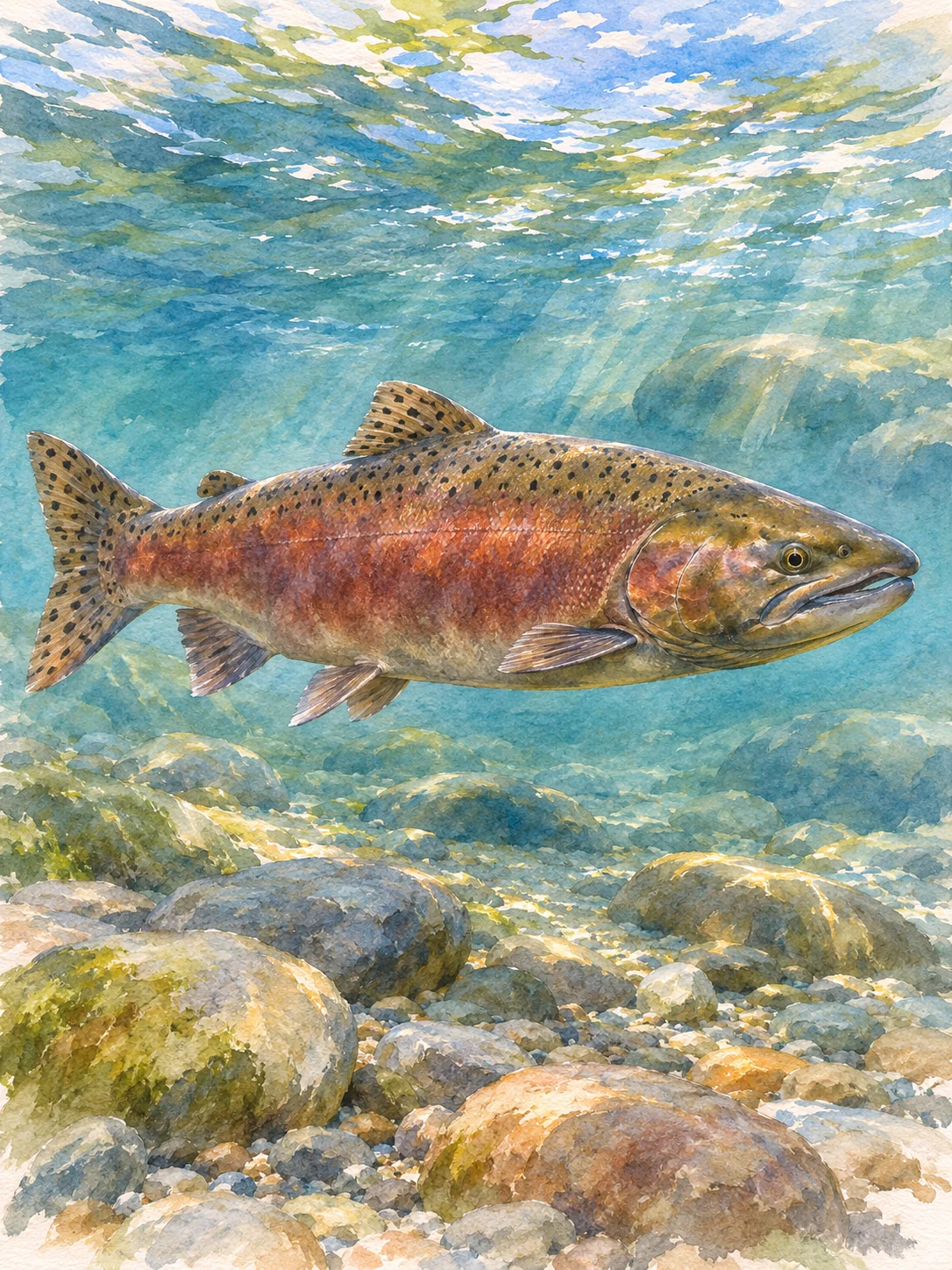
- Metallic blue-green and silver at sea; often olive-bronze to copper or maroon as spawning approaches. Small black spots occur on the back, dorsal fin and both lobes of the tail. [1, 2]
- BC range
- Major river systems and coastal waters, including Vancouver Island, the Fraser, Skeena and Nass watersheds, and northern and transboundary rivers. [2, 3, 5]
How to recognize it
Chinook are the largest of the five Pacific salmon species found in British Columbia. Look for a deep, muscular body, a broad head and numerous dark spots along the back and across both the upper and lower lobes of the tail. The gums at the bases of the teeth are black, a useful distinguishing feature when the mouth can be seen clearly. [1, 2]
Coho Salmon can look similar, but their dark tail spots are generally concentrated on the upper lobe and their lower gums are pale. Spawning Chinook develop bronze, brown or reddish tones; mature males may have a hooked upper jaw, called a kype. Colour and body shape change with life stage and time spent in fresh water. [1, 2]
Where it lives
Chinook connect some of BC's largest watersheds with coastal estuaries and ocean feeding grounds. Adults return to spawning reaches in mainstem rivers and sizeable tributaries, often using deeper, faster water and larger gravel than several other Pacific salmon. Eggs develop beneath well-oxygenated riverbed gravel. [2, 3]
Young fish use different habitats as they grow. Estuaries and tidal channels can provide food and shelter during the transition to salt water. Others remain in cool river habitats longer before heading seaward. No single river, migration route or seasonal schedule describes all BC Chinook populations. [2, 3, 11]
A life between river and sea
Chinook hatch in streambed gravel and begin life as tiny fish carrying a yolk sac. After emerging, juveniles feed and grow in fresh water before becoming smolts, young salmon adapting to salt water. Some ocean-type Chinook migrate toward the sea during their first year, while stream-type Chinook commonly spend a full year or more rearing in rivers. [2, 3]
At sea, growing Chinook feed on invertebrates and fish such as Pacific herring. After several years, adults return to fresh water. BC populations enter rivers in spring, summer or autumn, and their spawning schedules vary widely. Females use powerful tail movements to prepare nests in gravel, called redds, where they deposit thousands of eggs. Adults die after spawning, completing a life cycle that brings marine nutrients inland. [1, 2, 6]
Why Chinook matter
Chinook link riverbeds, estuaries, offshore food webs and coastal forests. Their eggs and young contribute to aquatic food webs. Returning adults provide food for wildlife, including Bald Eagles, bears and River Otters where these species overlap. Salmon remains can move nutrients from the ocean into streamside soils and vegetation. [2, 6]
In coastal waters, Chinook are especially important prey for endangered Southern Resident Killer Whales. Their survival connects the condition of rivers and estuaries with the health of marine ecosystems far beyond the spawning grounds. [7]
First Nations relationships and stewardship
Chinook Salmon are part of living Indigenous food systems, knowledge and stewardship across British Columbia. Relationships, responsibilities and harvesting practices vary among Nations and watersheds. They should not be reduced to one province-wide account.
One documented example is Bringing the Salmon Home, an Indigenous-led initiative involving the Syilx Okanagan, Ktunaxa and Secwépemc Nations. Its work to restore salmon to the Upper Columbia River system connects ecological recovery with the Nations' continuing relationships to these waters. [8]
Conservation: one species, many populations
Chinook Salmon are widespread across the North Pacific, but their BC populations do not all face the same conditions. COSEWIC assesses geographically and biologically distinct groups called designatable units. For example, it assessed the Okanagan population as Endangered in 2017; its 2018 and 2020 assessments identify additional southern BC populations ranging from Endangered or Threatened to Special Concern or Not at Risk. [3, 4, 11]
COSEWIC assessments describe risk; they are not automatically the same as legal listing under Canada's Species at Risk Act. Pressures vary by watershed and can include warming water, altered streamflows, habitat loss, barriers to migration and changing conditions at sea. Conservation efforts therefore need to reflect the needs of each population and its habitats. [3, 4, 11, 12]
Five details worth noticing
- Chinook have dark spotting on both tail lobes, a practical clue when distinguishing them from Coho Salmon. [1]
- A large coastal Chinook may be called a tyee, a name traditionally used for especially big fish. [2]
- Not all Chinook rush to sea as fry. Some young fish spend a year or more growing in fresh water before migrating. [2, 3]
- Some Chinook naturally have pale, ivory-coloured flesh rather than red flesh, a heritable difference in how pigments are deposited in the muscle. [13]
- Research in the Strait of Georgia has found young Chinook feeding during their first winter at sea, highlighting how much scientists are still learning about this life stage. [9]
A respectful way to experience a salmon run
Watch from a safe distance on the riverbank or an established viewing area. Keep dogs out of active spawning reaches, avoid wading across gravel nests and never move rocks or disturb fish. Water can be swift and cold even when a stream looks shallow. Follow local access rules and any site-specific guidance from First Nations or conservation organizations. [10]